Florida Historical Marker Details
DE SOTO WINTER ENCAMPMENT SITE 1539-1540
City: Tallahassee
County: Leon
Year: 1998
Location: De Soto State Park, De Soto Drive
In 1539, a Spanish expeditionary force led by Hernando De Soto landed in the Tampa Bay area. Nearly 600 heavily armed adventurers traveled more than 4000 miles from Florida to Mexico intending to explore and control the Southeast of North America. The route of de Soto has always been uncertain, including the location of the village of Anhaica, the first winter encampment. The place was thought to be in the vicinity of present day Tallahassee, but no physical evidence had ever been found. Calvin Jones’ chance discovery of 16th century Spanish artifacts in 1987 settled the argument. Jones, a state archaeologist, led a team of amateurs and professionals in an excavation which recovered more than 40,000 artifacts. The evidence includes links of chain mail armor, copper coins, the iron tip of a crossbow bolt, Spanish olive jar shards, and glass trade beads. The team also found the jaw bone of a pig. Pigs were not native to the New World and historical documents confirm that the expedition brought swine. These finds provided the physical evidence the 1539-40 winter encampment, the first confirmed de Soto site in North America. From this location, the de Soto expedition traveled northward and westward making the first European contact with many native societies. Within two centuries, most of the southeastern native cultures were greatly diminished by the affects of European contact and settlement.
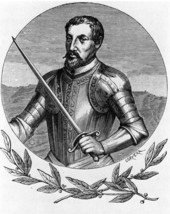
Engraving of Hernando de Soto 15--
View on Florida Memory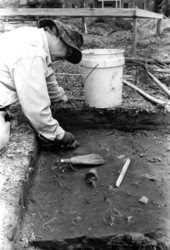
1987 Photo of excavation
View on Florida Memory
1987 Photo of Calvin Jones during excavation
View on Florida Memory
1987 Photo of Calvin Jones during excavation
View on Florida Memory